Editorial
Allah the Almighty, Who created humankind in the finest form, has
placed at their service numerous material and spiritual blessings so
that they may sustain their life on earth. Allah, Who has made the earth
habitable for humankind, sends down rain from the sky and brings
forth various blessings from the earth to meet their needs, making all
these blessings available for their benefit. The fundamental principle
that people are to observe when benefiting from these blessings is
expressed in the Holy Qur’an as follows: “O humanity! Eat from what is
lawful and good on the earth.” (Baqarah, 2:168)
Islam requires people to observe certain principles with regard to
nutrition as well. Accordingly, Islamic scholars have undertaken
comprehensive assessments concerning the halal and haram status of
foods and beverages in light of the Qur’anic verses and the sunnah of
the Prophet Muhammad (saw). The subject of halal food encompasses
not only whether a product is religiously permissible for consumption,
but also various dimensions such as human health, reliability, and
individual responsibility. Therefore, being mindful of the quality,
hygiene, ethical production, and source of the food consumed is among
the matters to which Muslims should attach importance.
Today, the increasing complexity of food production and consumption
processes makes it necessary to address the subject of halal food
from new perspectives. Numerous issues, including the additives
used in food production, processing methods, production and supply
processes, and product certification, require consumers to act with
greater awareness. Furthermore, the development of halal food
standards and their implementation across different countries are
gaining importance at the international level. These developments
underscore the importance of accurate and reliable information on
halal food, as well as common standards and effective inspection
mechanisms.
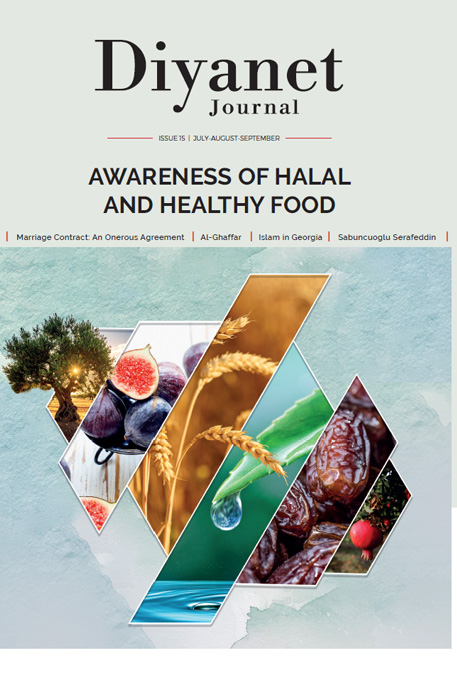
In this issue of Diyanet Journal, we explore the theme of “Awareness of
Halal and Healthy Food.” As part of our feature, Ismail Sert, emphasizes
that consuming halal and healthy food is a responsibility incumbent
upon every Muslim in the Agenda column. In our interview, SMIIC
Secretary General Ihsan Ovut addresses a range of issues, particularly
compliance with SMIIC standards, accreditation, and international
practices relating to halal food. We hope that this issue, which aims
to contribute to the development of accurate knowledge and greater
awareness regarding halal food, will be beneficial to our readers.
Gulhiman HEKIMOGLU